


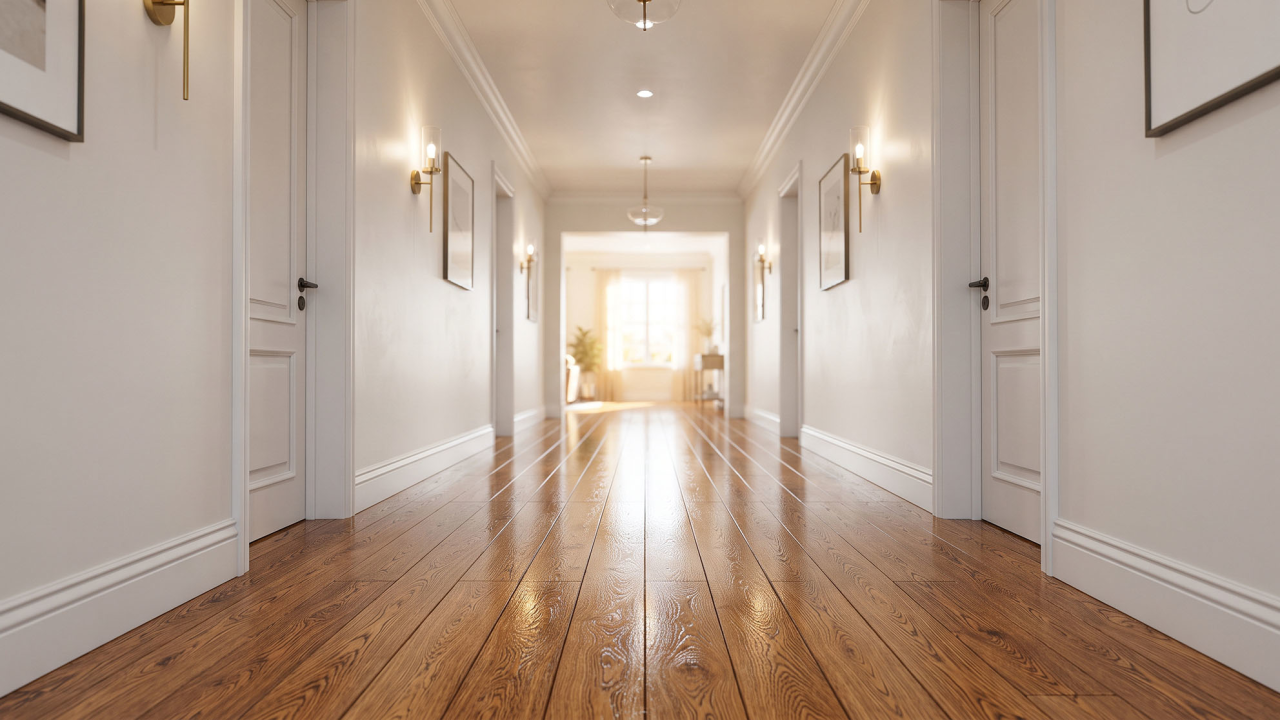
Solid hardwood floors bring timeless beauty, warmth, and resale value to any property. However, living in Oldsmar, Florida, means operating in a high-humidity environment surrounded by Safety Harbor and Tampa Bay. Moisture is the ultimate adversary of natural timber, but with the right product selection, indoor climate management, and maintenance routines, you can enjoy gorgeous hardwood floors that remain stable and flat for decades.
How Humidity Affects Natural Hardwood
Wood is a natural, hygroscopic material, meaning it constantly absorbs and releases moisture from the surrounding air to stay in equilibrium with its environment. When relative humidity rises, wood fibers absorb water vapor and expand across the width of the plank. When humidity drops, the wood releases moisture and shrinks.
In a coastal climate like Oldsmar’s, unmanaged interior humidity leads to specific structural issues:
Cupping: The edges of a plank rise higher than its center, creating a wavy profile across the floor.
Crowning: The center of the plank bulges higher than the edges, often caused by sanding a cupped floor before it fully dried out.
Gapping: Visible spaces open up between planks during drier winter periods when indoor heating is used.
Buckling: In extreme cases, swelling forces planks entirely off the subfloor.
Solid Wood vs. Engineered Hardwood in Coastal Environments
Because of persistent outdoor moisture, solid wood planks (which consist of a single piece of lumber throughout) are generally risky for ground-level installations on Florida concrete slabs.
Engineered hardwood is purpose-built to solve this problem. Engineered planks feature a top layer of genuine hardwood (the wear layer) bonded over multiple cross-ply layers of high-grade plywood or dense fiberboard. These alternating layers run perpendicular to one another, neutralizing the natural tendency of wood to expand and contract. Engineered hardwood offers the exact look, feel, and refinishing potential of solid wood while maintaining superior dimensional stability against Florida humidity.
Climate Control Strategies for Oldsmar Homeowners
Keeping real hardwood floors healthy requires maintaining a steady interior environment. Ideally, your home's relative humidity should stay between 35% and 55% year-round, with temperatures kept between 60°F and 80°F.
To maintain these conditions:
Keep the AC Running: Never shut off your central air conditioning completely when traveling during the summer. Set the thermostat to a reasonable maximum (such as 76°F–78°F) to ensure the system continues extracting humidity from the air.
Use Whole-Home Dehumidifiers: If your HVAC unit alone cannot keep interior humidity below 55% during muggy summer months, an integrated or standalone dehumidifier provides essential moisture control.
Monitor Interior Levels: Install a basic digital hygrometer in your living area to keep track of indoor relative humidity daily.
Daily Care Rules to Prevent Moisture Damage
Protecting your hardwood finish requires adapted cleaning habits. Never use steam mops on hardwood floors, as blast-forced steam forces moisture deep into the grain and destroys the protective finish. Likewise, avoid wet-mopping with sloshing buckets of water.
Instead, sweep or dry-vacuum regularly using a soft brush attachment to remove abrasive sand particles. Clean surfaces using a micro-fiber mop lightly misted with a pH-neutral hardwood floor cleaner designed specifically for your floor's finish (polyurethane, aluminum oxide, or hard-wax oil). Clean up liquid spills, wet pet paws, and umbrella drips immediately to keep moisture from sitting on top of seam lines.
Preserve the Warmth of Real Wood
Living near the bay doesn't mean you have to forfeit the luxury of natural hardwood flooring. By choosing engineered wood structures and taking simple steps to manage your home's indoor climate, your hardwood floors will remain a centerpiece of your home for years to come.


